Rev'd Stephen Lovatt
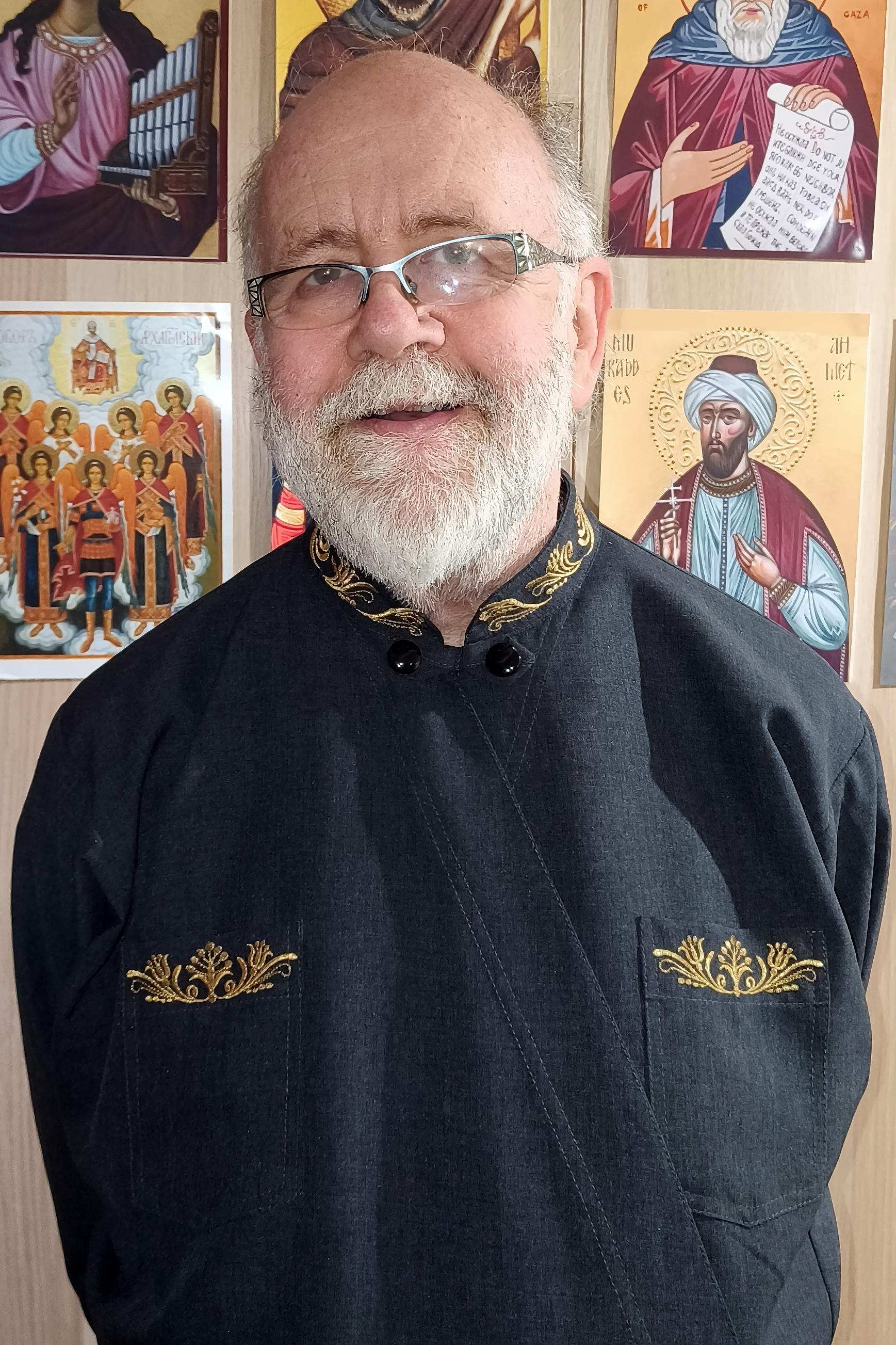
The Reverend Stephen Lovatt is the son of a semi-skilled potter. He was born (in 1958) and grew-up in Stoke-on-Trent, where he was a devout Methodist. He lost his mother when he was thirteen and his father when he was twenty-one. He was received into Catholic Communion in 1979 by Rev’d Maurice Coeve de Murville, who subsequently became Archbishop of Birmingham. He was ordained priest by Rt Rev’d Martyn Douglas in April 2p026.
Rev’d Lovatt has no formal theological or philosophical training beyond an O-level in OT religious studies, but is extensively read and self-taught He does have an MA in Natural Science (that is Theoretical Physics) from Cambridge University; a PGCE in Adult Education from Portsmouth University; and a PhD in Theoretical/Computational Physics from Bristol University.
He has had a varied career: as an Electronic Engineer, Scientific Computer Programmer, and teacher of Physics and Electronics. He has self-published a number of books of Philosophy, Theology, and Poetry.
He is particularly interested in Epistemology; the Philosophy of Science; the Basis of Quantum Mechanics; the Hard Problem of Consciousness; Christology; Soteriology; Ethics – especially “sexual” ethics; and Liturgy.
Rev’d Lovatt is a keen gardener and regular gym-goer. He has played a lot of Dungeons-and-Dragons and has more recently devoted many an hour to the PC role-playing game Skyrim.
1. He has a resolute commitment to orthodoxy.
2. He is implacably opposed to Progressivism, PostModernism, and Subjective Relativism in all its forms.
3. The idea of a developing tradition, as enunciated by John Henry Newman is central to his thought.
4. He is opposed to legalism and formalism. He is sure that empathy, compassion and originality yield better fruits than do rigour and conformity.
5. He has a strong attachment to traditional forms of worship, with a personal preference for Eastern (Greek/Slavonic/Byzantine) liturgy.
6. He is convinced that reason and rationality goes hand-in-hand with faith; and that any proper theology and morality must necessarily be compatible with empirical facts and the reality of definite human experience.